
Holy Spirit & Spiritual Maturity
The Sevenfold Spirit of God and the Rooted Lampstand
God calls His people to grow into the likeness of Jesus and to serve from a life shaped by His Spirit. Spiritual maturity involves character, understanding, obedience, and dependence on God.
Isaiah 11:1–3 describes the Spirit resting upon the Branch, while Revelation speaks of the seven spirits of God. A rooted, seven-lamp menorah provides a picture of this sevenfold work. The center represents the Spirit of the Lord. The six side branches form three pairs: wisdom and understanding, counsel and might, and knowledge and the fear of the Lord.
Growing into the likeness of Christ
Restoration is part of spiritual maturity. People who have endured difficult battles may need healing, renewed strength, and freedom from heaviness before they can pour themselves out in ministry. That restoration should also enlarge our compassion for people outside the church, helping us see the people God loves rather than allowing political or cultural divisions to close our hearts.
Second Samuel 23:1–5 gives a picture of leadership marked by righteousness and the fear of God. Such leadership brings light and helps life grow. Authority and anointing are therefore connected to the kind of people we become and the way we treat those entrusted to us.
Maturity also means building on the foundations of faith. The appeal to Hebrews 6 is an invitation to grow beyond an elementary stage while retaining what is true. Justification by faith and the basic truths of the gospel remain the foundation. Growth should make those truths more visible in our lives.
This growth prepares a company of mature sons of the kingdom. Drawing on the harvest imagery of Matthew 13, the expectation is for a people who increasingly reflect Christ and serve in the power of His Spirit. Maturity is not simply knowing more; it is becoming more like Christ and being prepared to carry His life faithfully.
The rooted lampstand
Picture a lampstand with roots at its base, as though it were growing from a seed. The central stem supplies every branch. Three pairs curve outward from that stem, holding six lamps around the central lamp. The image joins the language of Christ as the Branch with the sevenfold work of the Spirit.
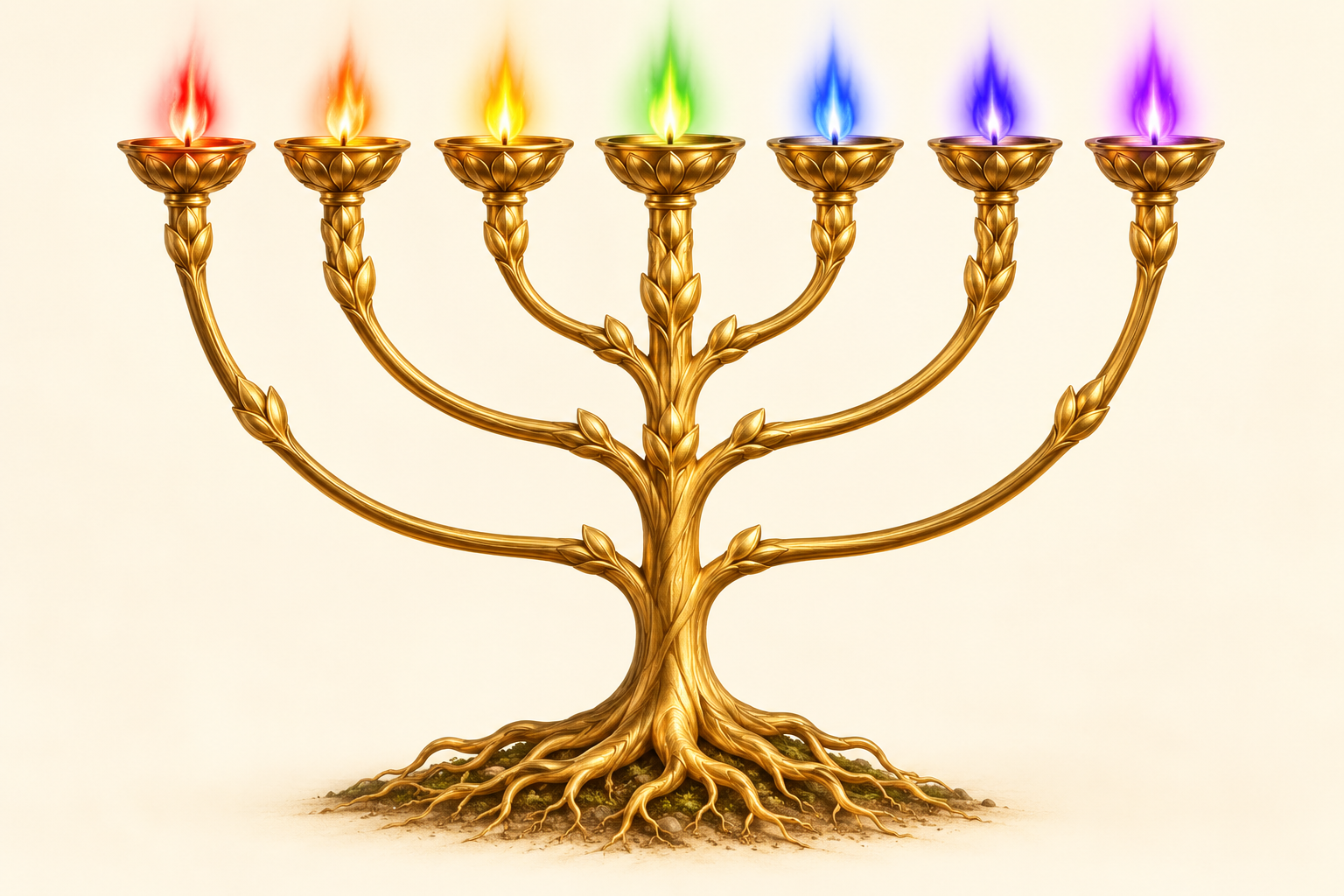
| Position from left | Color | Meaning |
|---|---|---|
| 1 | Red | Wisdom |
| 2 | Orange | Counsel |
| 3 | Yellow | Knowledge |
| 4 — Center | Green or greenish amber | The Spirit of the Lord |
| 5 | Blue | The fear of the Lord |
| 6 | Indigo | Might |
| 7 | Violet | Understanding |
Christ as the Branch and the source of life
Isaiah 11 begins with a shoot coming from the stump of Jesse and a branch bearing fruit from his roots. The Spirit of the Lord rests upon this figure. Zechariah 6:12 presents Christ as the Branch, and Revelation 5:5 identifies Him as the Root of David. The rooted lampstand gives a visual form to those connections.
The roots matter because this is a picture of life that grows. A seed is planted, watered, and brought toward maturity. In the same way, believers are called to allow what God has placed within them to develop through preparation, refinement, and obedience. The idea of spiritual DNA expresses a God-given calling and a growing likeness to Christ.
Revelation 4:5 describes seven burning torches before the throne as the seven spirits of God. Revelation 5:6 connects the seven spirits with the Lamb’s seven eyes sent into the earth. Read alongside Isaiah 11:2, the menorah becomes a useful symbolic picture of the relationship. No single passage supplies the entire diagram, so the connection should be understood symbolically rather than as a direct biblical blueprint.
The central stem represents the Spirit of the Lord
Every branch belongs to one lampstand and receives its support from the center. Wisdom, understanding, counsel, might, knowledge, and reverence belong together in the work of the Holy Spirit. They are not separate abilities that we operate independently of Him.
This has a practical direction. Our first concern is our relationship with the Lord and our responsiveness to His presence. We cannot manufacture spiritual authority by copying a method. We need to recognize what the Spirit is doing and yield to Him.
Wisdom and understanding
Wisdom and understanding form the outer pair of branches. Receiving something from God is not the same as understanding what it means. A person may see an image, receive an impression, or recognize that God is drawing attention to something, yet still need clarity about it.
Gabriel helped Daniel understand what had been shown to him. Revelation and understanding should work together. Seeing something is not the end of the process. We need to understand its meaning before assuming that we know how to respond.
That means bringing what we receive back before the Lord. We should seek the understanding that makes the insight useful. Believers are called to grow beyond unexplained experiences into a mature ability to cooperate with God.
Counsel and might
Counsel and might form the middle pair. Counsel is the direction God gives. Might is the power by which He accomplishes what He has directed. The two are joined through obedience: hear what God says, follow His direction, and depend on Him for the result.
Elijah’s confrontation with the prophets of Baal is one example. Elijah said that he had acted at the Lord’s word (1 Kings 18:36). He was responding to God’s instruction. The unusual details of the altar and the water were part of an act of obedience, followed by God’s answer.
The same principle appears in the examples of Naaman and the man born blind. Naaman was told to wash in the Jordan seven times (2 Kings 5). Jesus directed the blind man to wash in the pool of Siloam after applying mud to his eyes (John 9:1–7). In both accounts, the instruction called for a response before the person saw the outcome.
We should not invent our own plan and then assume that God must support it. The question is whether we have received His counsel. His direction may challenge our expectations or preferences. These biblical accounts call for careful obedience and reliance on God’s power rather than treating outward actions as techniques to repeat mechanically.
Knowledge and the fear of the Lord
Knowledge and the fear of the Lord form the inner pair, closest to the central stem. When God reveals what He knows, people become aware that they are personally known by Him. That awareness can bring reverence, honesty, repentance, and awakened faith.
Accounts from earlier healing meetings describe details about people’s lives being spoken publicly. The impact went beyond amazement at the information. People examined their hearts and became deeply conscious of God’s presence. The value of such accounts is not the spectacle, but the way a person can become aware that God knows them completely.
Knowledge should serve God’s purpose in people. It can bring people face to face with the Lord who knows them. Reverential fear means taking Him seriously, honoring His holiness, and responding sincerely.
The three pairs belong together. Wisdom needs understanding. Counsel calls for obedience and dependence on divine might. Knowledge should deepen reverence. All three pairs remain connected to the Spirit of the Lord at the center.
A life shaped by the abiding Spirit
There is an important difference between a passing experience of spiritual power and an ongoing life of responsiveness to the Holy Spirit. The gifts described in 1 Corinthians 12 remain important, but believers should also seek a deeper and more consistent participation in the Spirit’s work.
A river gives a helpful picture. Receiving a particular word of knowledge or wisdom can be compared with drawing something from the river. A fuller life in the Spirit is like entering the river and moving with its flow. The point is ongoing dependence on the Holy Spirit, not a replacement for the biblical gifts.
Jesus is the pattern. In John 1:32–33, the Spirit descends and remains on Him. The word remains is important. It contrasts with many Old Testament accounts in which the Spirit came upon people for particular acts of service. Believers should pursue a life in which God’s presence increasingly shapes who they are and how they minister.
This also changes how we think about revival. A place or gathering can be marked by God’s presence, but the greater goal is a people who carry a life of faith and obedience wherever they go. A powerful encounter with God should produce something that continues afterward.
Learning to recognize what God is doing
Jesus said He did what He saw the Father doing (John 5:19). Believers should become more sensitive to the Holy Spirit’s present purpose. If God is drawing people toward healing, counsel, repentance, or understanding, we need to recognize that direction and cooperate with it.
Seeking breakthrough with a purpose
What are we seeking breakthrough into? Financial relief, help for our families, healing, and freedom from difficult circumstances all matter. But there is a larger purpose: becoming a mature people who can faithfully express the life and ministry of Christ.
Breakthrough means moving beyond a familiar pattern of ministry into deeper understanding, obedience, and participation in the Holy Spirit’s work. It includes a call for the church to mature together and become more fully prepared to carry the life of Christ.
Personal inadequacy is not a reason to withdraw. Second Corinthians 3:5–6 reminds us that our sufficiency comes from God. Our natural limitations should not become the final measure of what God can do through us. At the same time, believers need preparation, refinement, and a willingness to be shaped by Him.
The prayer of maturity can be simple: Lord, water the seed You have planted and bring it to fullness. Ezekiel 9 also presents the image of a mark placed on the forehead of those who grieve over sin and corruption. Whatever experiences may accompany prayer, the focus should remain on God’s work of preparing and refining His people.
Putting it into practice
Begin with the Lord Himself. Ask Him to restore what has become weary and to deepen the character needed for faithful service. Seek understanding when something is unclear. When His direction is clear, respond with obedience and leave the result in His hands.
Allow the knowledge of God to produce reverence and honesty. Consider what has taken root in your life and what still needs to mature. Pause long enough to receive what God is doing and give His word time to settle rather than immediately rushing into the next activity.
Scripture Guide
Read these passages together to follow the main biblical connections. The lampstand colors and links to reported modern experiences are symbolic interpretations rather than explicit statements of Scripture.
| Passage | Connection |
|---|---|
| 2 Samuel 23:1–5 | Righteous leadership and the fear of God |
| Isaiah 11:1–3 | The Branch and the qualities of the Spirit |
| Exodus 25:31–40 | The golden lampstand with its central stem and six side branches |
| Zechariah 6:12; Revelation 5:5–6 | Christ as the Branch and Root of David; the seven spirits |
| Revelation 4:5 | Seven burning torches before the throne |
| 1 Kings 18:36–39; 2 Kings 5:9–14; John 9:1–7 | God’s direction and the response of obedience |
| John 1:32–33; John 5:19 | The Spirit remaining on Jesus; doing what the Father does |
| Matthew 13:37–43; Hebrews 6:1, 5 | The sons of the kingdom, maturity, and the coming age |
| 1 Corinthians 12; 2 Corinthians 3:5–6 | Spiritual gifts and sufficiency from God |
| Ezekiel 9:4 | A biblical picture of a mark associated with grief over sin and corruption |
Scripture text can be read at ESV.org. The passages are summarized here rather than reproduced at length.